

Colombia Peach Co-Ferment
Colombia Peach Co-Ferment
| country | Colombia |
|---|---|
| region | Circasia, Quindío, Colombia |
| farm | Finca Campo Hermoso |
| producer | Edwin Noreña |
| altitude | 1650 masl. |
| varietal | Caturra |
| process | peach co-ferment honey |
| notes | peach, jasmine, black tea |
| profile | fruity, floral, exotic |
| roasted by | No6 Coffee Co. |
| importer | Royal Coffee |
This coffee from Edwin Noreña at Finca Campo Hermoso in Quindío, Colombia is a high-intervention carbonic honey process co-fermented with peaches. The cup is unapologetically peachy, with intense gummy-candy sweetness, floral aromatics, and layered stone-fruit flavours of peach, apricot, and nectarine.
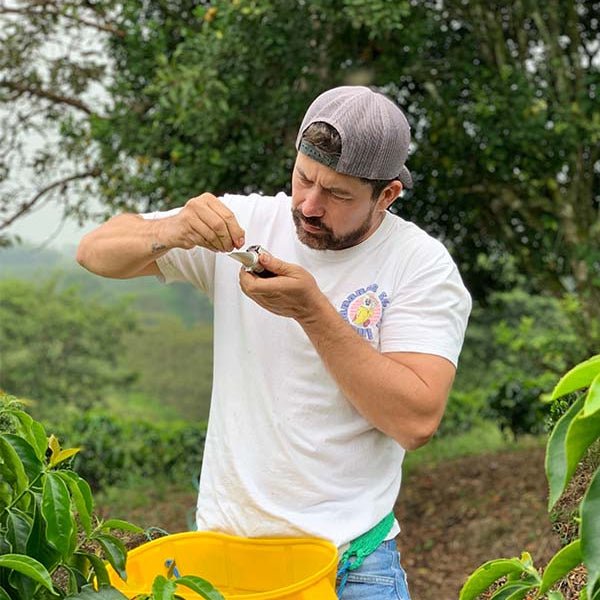
Edwin Noreña is one of Colombia’s most experimental coffee producers. Known among friends as El Alquimista(the alchemist), he has developed an extensive range of fermentation profiles, often layering multiple fermentations to shape a specific flavor expression.
This particular microlot was produced using two carefully controlled whole-cherry fermentations. The second fermentation is enriched with a solution derived from the first fermentation and infused with dehydrated fruit. The result is an expressive and layered cup with jasmine-like florals and vibrant sweetness reminiscent of fruit gummies, watermelon jelly, maple syrup, and pink lemonade, playful, complex, and far more refined than those descriptors might suggest.
Finca Campo Hermoso, Quindío
Quindío is one of Colombia’s smallest departments, yet it sits directly along the central range of the Andes and has long been part of the country’s coffee heartland. Nearly the entire region lies above 1000 meters in elevation, with mountainous terrain and a landscape densely planted with coffee farms.
Finca Campo Hermoso is a 15-hectare farm located near the town of Circasia, just outside the regional capital of Armenia. The farm is run by Edwin Noreña, an agro-industrial engineer with graduate studies in biotechnology. His work focuses on pairing specific coffee varieties with highly intentional processing methods designed to create distinctive and memorable flavor profiles.
The farm cultivates a wide range of coffee genetics, including Pink Bourbon, Yellow Bourbon, Yellow Caturra, Bourbon Sidra, Gesha, and Cenicafé 1, a disease-resistant hybrid developed by Colombia’s national coffee research institute.
For Edwin, fermentation has always been the most fascinating stage of coffee processing because of its ability to transform raw seeds into a complex sensory experience. One of his key breakthroughs came from recognizing that the sugary liquid produced during fruit fermentation, similar to the “must” used in winemaking, could be reused in subsequent fermentations. This liquid contains natural sugars and microorganisms that can influence flavor development.
Over time, he began experimenting with co-fermentation using ingredients such as chili, ginger, brewing hops, and dehydrated fruit to create distinctive flavor profiles in small microlots.
Processing
The processing for this lot involves two separate whole-cherry fermentations.
Freshly harvested cherries are first carefully sorted for ripeness, washed, and placed into sealed fermentation tanks with limited oxygen for approximately 24 hours. During this stage the cherries soften and sugars begin to break down, producing a thick, sugary liquid known as mossto or fermentation must.
After this initial fermentation, the cherries are separated from the mossto. The mossto is then fermented independently with yeast and dehydrated fruit to build additional sugars and aromatic compounds.
The flavored mossto is later reintroduced to the coffee cherries in small quantities and sealed in tanks for a second fermentation lasting approximately 72 hours.
Following fermentation, the cherries are lightly depulped—leaving most of the sticky mucilage intact, similar to a dark honey process, and transferred to raised drying beds in a greenhouse where they dry for about ten days.
Once fully dried, the coffee is rested to allow moisture levels to stabilize before being stored and evaluated.
Although the coffee uses Caturra—a classic Colombian variety that has been widely grown for decades, the distinctiveness of the cup comes not from the genetics alone, but from the meticulous farming, harvesting, and carefully designed fermentation approach.
Some experimental coffees shout their process in the cup. The most successful ones integrate those techniques seamlessly, creating flavors that feel surprisingly natural despite the extraordinary amount of work behind them.
Clean Coffee
Clean Coffee

We believe coffee should be both delicious and responsibly sourced. That’s why we only work with specialty-grade coffees that are carefully harvested, dried, and stored. The result is clean, safe coffee that reflects the care of everyone involved.
We’ve had a few questions lately about mold and mycotoxins in coffee. These concerns are understandable, especially with the rise of health-focused media highlighting potential contaminants in commodity-grade coffees. But it's important to contextualize this issue within the specialty coffee supply chain.
Mycotoxins, such as ochratoxin A (OTA) and aflatoxins, can develop when green coffee is improperly processed, dried too slowly, or stored in environments with high humidity and poor ventilation. These conditions are more common in lower-grade, bulk commodity coffees that are harvested and handled with minimal oversight.
The coffees we buy, on the other hand, are traceable, meticulously processed, and stored under controlled conditions. We work exclusively with specialty importers who conduct rigorous quality control at origin and upon arrival, including moisture content analysis, water activity measurements, and sensory evaluation. Coffees showing any signs of mold contamination would be eliminated long before they reach us. Moldy lots not only pose a safety risk, they simply don’t taste good and would fail basic cupping protocols.
While mold and mycotoxin testing isn’t typically a requirement in the specialty sector, it’s also not absent. In some producing countries, OTA testing is mandatory for export. And in others, lots above a certain size are routinely spot-checked by local quality control authorities. More importantly, the stringent handling and drying practices required to meet specialty standards make the presence of harmful mycotoxins highly unlikely.
We’re also attentive to how we store our green coffee, in sealed GrainPro bags, in a stable, low-humidity environment, and roasted in small batches to maintain quality and freshness.
If you'd like to dive deeper into specific protocols, we're happy to talk more. In short, we only work with importers we trust, who work with producers they trust, and quality control is built into every step. The coffees we choose to roast are clean, carefully handled, and selected with intention.
Schedule
Schedule
Our weekly ordering cutoff is Tuesday at 9am. All orders placed before this time will be roasted, packaged and shipped by Wednesday. All orders received after this time are subject to shipping the following week depending on overflow.
Shipping Rates
Shipping Rates
Our current shipping rates are as follows:
Local Delivery Rates within 2km
$5.00 for orders between $0-$20
$2.50 for orders between $20-$40
FREE for orders over $40
Canadian Shipping (with tracking)
Standard rates for orders between $0-$36
$10 for orders between $36-$75
FREE for orders over $75
US Shipping (with tracking)
Standard rates for orders between $0-$100
FREE for orders over $100
Packaging
Packaging
100% Recyclable
Our coffee bags are made of 100% recyclable plastic and widely accepted at recycling depots across Canada, making it easy for you to responsibly dispose. Its recyclable materials ensure that it can be repurposed efficiently, contributing to environmental sustainability efforts and promoting a circular economy model.
Volume Discounts
Volume Discounts
We're dropping the bomb on exclusive volume discounts on our entire coffee collection. Mix and match any single origin and/or blends and get the following discounts automatically applied at checkout.
| 15 - 44 bags | 10% off |
| 45 - 89 bags | 15% off |
| 90 - 179 bags | 20% off |
| 180+ bags | 25% off |
Out of stock
10 bags, mix & match = 5% discount
15 bags, mix & match = 10% discount
Automatically applied at checkout.
Couldn't load pickup availability