

Finca Libre CM
Finca Libre CM
| country | Nicaragua |
|---|---|
| region | Los Arados, Nueva Segovia |
| farm | Finca Libre |
| producer | Pil Hoon Seu |
| altitude | 1570-1690 masl. |
| varietal | Parainema |
| process | natural carbonic maceration |
| notes | berry, grape, toffee |
| profile | wild, sweet, tropical |
| importer | Common Goal |
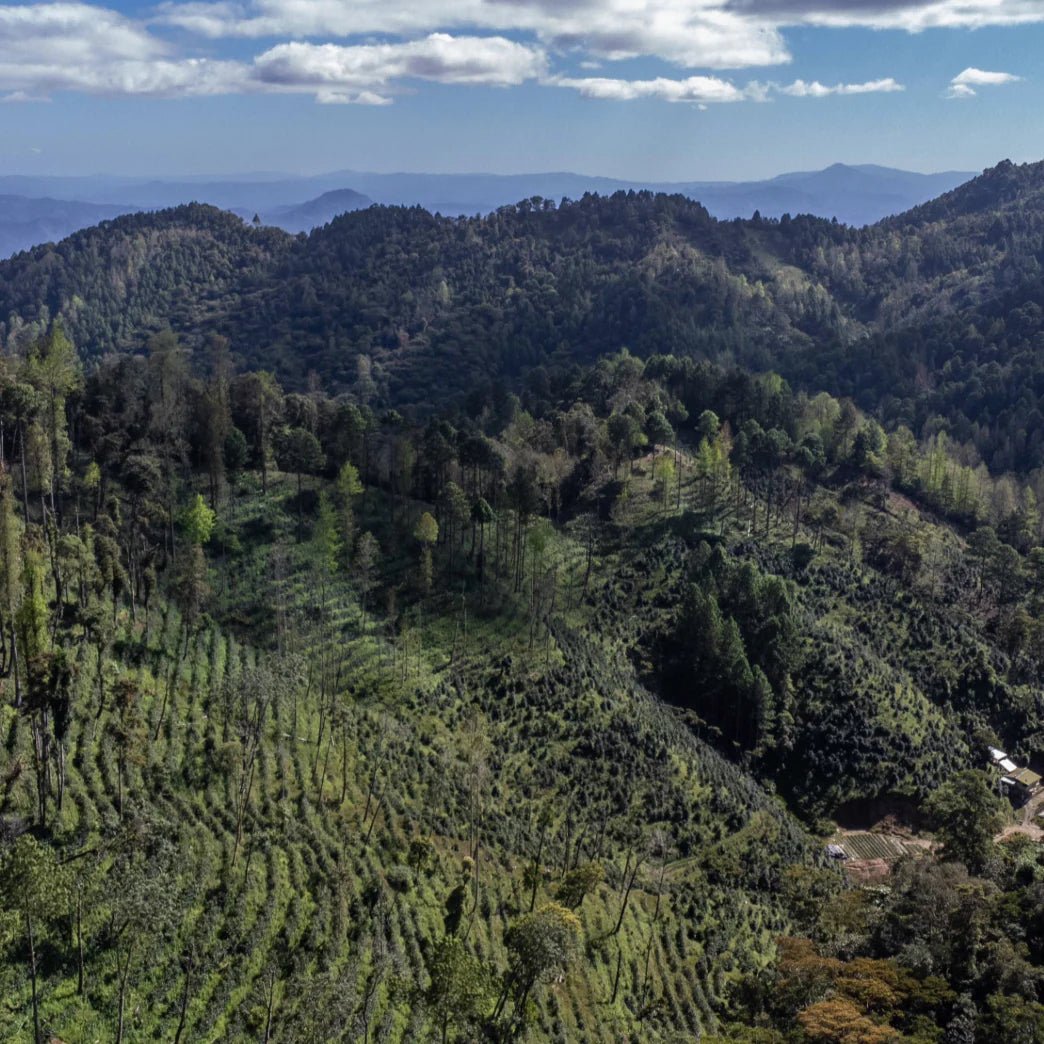
Finca Libre sits in El Pinabete, in the Los Arados area of Mozonte, Nueva Segovia. It’s a relatively young, experimental farm focused on pushing quality through variety selection and processing.
The farm ranges from 1570 to 1630 meters above sea level, altitude that shows up clearly in the cup. It spans 24.5 hectares, with a significant portion currently being renovated, which gives you a sense of how actively the project is evolving.
Planting is diverse by design. Geisha makes up about 5 hectares, alongside smaller lots of Kenya, Pink Bourbon, K7, and Parainema. There’s also Ethiopian Heirloom, SL28 and SL34, with Red Catuai forming the backbone of the farm. Each variety is treated as its own expression rather than blended into a single profile.
For this lot, the focus is on carbonic maceration, a process borrowed from winemaking but adapted carefully for coffee.
Whole cherries are sealed in tanks and held at cool, controlled temperatures. As fermentation begins, the fruit produces CO₂, pushing out oxygen and creating an anaerobic environment. This allows fermentation to happen within the cherry itself, rather than from the outside in.
Over several days, the cherries take on a dense, almost gelatinous texture.
From there, they’re moved to raised beds inside the same controlled environment to stabilize before finishing drying outside on African beds.
The result is a coffee with more structure and depth, fruit-forward, but not loud. Controlled, not chaotic.
Clean Coffee
Clean Coffee

We believe coffee should be both delicious and responsibly sourced. That’s why we only work with specialty-grade coffees that are carefully harvested, dried, and stored. The result is clean, safe coffee that reflects the care of everyone involved.
We’ve had a few questions lately about mold and mycotoxins in coffee. These concerns are understandable, especially with the rise of health-focused media highlighting potential contaminants in commodity-grade coffees. But it's important to contextualize this issue within the specialty coffee supply chain.
Mycotoxins, such as ochratoxin A (OTA) and aflatoxins, can develop when green coffee is improperly processed, dried too slowly, or stored in environments with high humidity and poor ventilation. These conditions are more common in lower-grade, bulk commodity coffees that are harvested and handled with minimal oversight.
The coffees we buy, on the other hand, are traceable, meticulously processed, and stored under controlled conditions. We work exclusively with specialty importers who conduct rigorous quality control at origin and upon arrival, including moisture content analysis, water activity measurements, and sensory evaluation. Coffees showing any signs of mold contamination would be eliminated long before they reach us. Moldy lots not only pose a safety risk, they simply don’t taste good and would fail basic cupping protocols.
While mold and mycotoxin testing isn’t typically a requirement in the specialty sector, it’s also not absent. In some producing countries, OTA testing is mandatory for export. And in others, lots above a certain size are routinely spot-checked by local quality control authorities. More importantly, the stringent handling and drying practices required to meet specialty standards make the presence of harmful mycotoxins highly unlikely.
We’re also attentive to how we store our green coffee, in sealed GrainPro bags, in a stable, low-humidity environment, and roasted in small batches to maintain quality and freshness.
If you'd like to dive deeper into specific protocols, we're happy to talk more. In short, we only work with importers we trust, who work with producers they trust, and quality control is built into every step. The coffees we choose to roast are clean, carefully handled, and selected with intention.
Shipping Rates
Shipping Rates
Our current shipping rates are as follows:
Local Delivery Rates within 2km
$5.00 for orders between $0-$20
$2.50 for orders between $20-$40
FREE for orders over $40
Canadian Shipping (with tracking)
Standard rates for orders between $0-$36
$10 for orders between $36-$75
FREE for orders over $75
US Shipping (with tracking)
Standard rates for orders between $0-$100
FREE for orders over $100
Packaging
Packaging

Biotrē™ 2.0 a des couches externes fabriquées à partir de pâte de bois et de cellulose à partir de pâte de bois. Dans Biotrē ™ 2.0 avec du papier Kraft naturel à l'extérieur, les couches extérieures représentent environ 60% du matériau en poids et il a été démontré qu'elles se décomposent en un compost sain en 12 semaines lorsqu'elles sont testées dans les conditions d'une méthode de test appelée ASTM D6868. La couche intérieure scellable de Biotrē™ 2.0 est constituée d'une ressource végétale renouvelable, la canne à sucre. Il s'agit d'une couche durable, c'est-à-dire non biodégradable, fabriquée à partir de sources végétales renouvelables. Le gaz à effet de serre CO2 est absorbé et réduit pendant la croissance de la plante.
Biotrē™ adopte une approche globale pour être respectueux de l'environnement.
- Réduction des déchets - Biotrē™ peut réduire la quantité d'emballages qui finissent dans le stockage à long terme des déchets comme une décharge.
- Biotrē™ 2.0 – les couches externes se décomposant naturellement dans un environnement de compostage en un temps relativement court, les emballages peuvent être traités dans un compost domestique pour convertir 60 % des matériaux (Biotrē™ 2.0 n'est pas recommandé pour le compostage municipal ou industriel) . La couche interne peut être retirée du compost si elle est trouvée et jetée avec les ordures normales. 60 % moins de matériaux vont à la décharge.
- Changement climatique - Les composants à base de plantes qui entrent dans Biotrē™ (pâte de bois, canne à sucre et maïs) absorbent le gaz à effet de serre CO2 par la respiration naturelle des plantes avant d'être utilisés pour fabriquer les emballages Biotrē™. L'absorption et la réduction de la quantité de CO2 dans l'atmosphère contribuent à endiguer la vague du changement climatique mondial.
- Ressources naturelles - Biotrē™ préserve nos ressources naturelles en réduisant l'utilisation de combustibles fossiles et de ressources minérales limitées et en favorisant l'utilisation de sources cycliques et durables. Alors que la plupart des emballages barrières sont fabriqués presque exclusivement à partir de plastiques à base de pétrole ou de feuilles d'aluminium, les couches de film Biotre® sont constituées de n'importe où pour 60 % à près de 100 % de plantes renouvelables.
En rupture de stock
Impossible de charger la disponibilité du service de retrait